Posts

What is demand paging(OS-9)

Image
Demand paging -Loading the entire program in the physical memory at program execution time is not so good because the user does not need the entire program in memory at a time. -An alternative strategy is to load pages only as they are need this technique is known as demand paging. -With demand paging virtual memory, pages are only loaded when they are demanded during program execution pages that are never accessed thus never loaded into physical memory.    -A demand paging system is a similar to paging system with swapping, -But here it uses a lazy swap where it never swap a pages into memory unless that page will be need. -In demand paging pager is more suitable than swap er. 

What is paging(OS-8)

Image
Paging -Paging is storage mechanism that allows operating system to retrieve a process from the secondary memory into the main memory in the form of pages. -In the paging method the memory is divided  into small fixed size block of the physical memory that is called frame. -The size of the frame should be kept the same as that of pages to have maximum utilization of the main memory and to avoid external fragmentation. -Paging is use for the faster access to the data and it is a logical concept. 

What is the swapping and explain of benefits of swapping(OS-7)

Image
swapping -A process can be swapped temporary out of memory to a backing store and then brought back into memory for continued execution. -Switching a process from the main memory to backing store is called swap out and switching a process from disk to the main memory is called swap in. -The swap out and swap in to process is called as swapping. -swapping is increase the context of switch.   Benefits of swapping: -It offer a higher degree of multi programming. -It allows a dynamic relocation. -It is help to get better utilization of the main memory.                     

Classification of memory allocation method(OS-6)

memory allocation techniques memory allocation techniques is two types :                                                                         1. continuous memory allocation                                                                        2.non-continuous memory allocation Continuous memory allocation: -In this memory allocation all available memory space remain together. It means freely available memory partition are not scatter here.Their across the whole memory space. -when any user process request for the memory a single section of the continuous memory block is given to the process according to its ne...

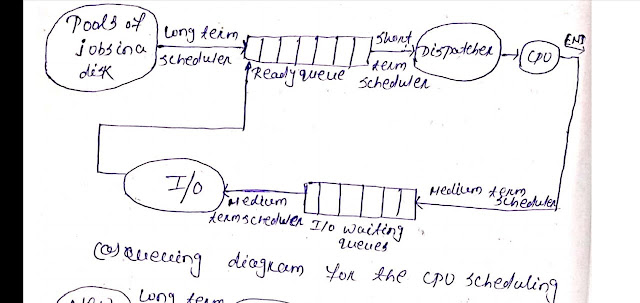
Define scheduler an explain the types of the scheduler(OS-5)

Image
Scheduler  -Scheduler is the special system software which handle the process scheduling in various ways. Their the main tasks is to select the jobs to be submitted into the system and to decide with process to run. -There are three types of scheduler:                                                         1.long term scheduler                                                         2.medium term scheduler                                                         3.short term scheduler  Long term scheduler: -It is also known as job scheduler. The fun...

Define the process control block(OS-4)

Image
Process control block -Each process is represented in the operating system by the process control block also called as task control block. -It contains many pieces of information associated with a specific process include these Process states: The state may be new/ready,running,waiting,haltered and soon. Program counter: The counter can be indicate to the address of the next instruction to be executed for this process. CPU registers: The register vary in number and type depending in the computer or architecture .they includes the accumulator,index register,stack pointer , general purpose of register. Memory management information: It may be includes such information as the value of the base and limit register, the page tables or segment tables depending on the memory system used by the operating system. Accounting information: It includes the account of the CPU and real time used,time limits account number,job or process number and soon. I/O status inf...

Draw process state diagram and explain each state(OS-3)

Image
-Process state means current activity of process. -When process is execute it changes the state generally state of process is determine by the current activity of process. -Each process may be in one of the following state. new- the process is being is oriented. ready- the process is waiting to be assigned to the processor. waiting - the process is waiting for some event (I/O operation) to occur. running - the process is being executed.  terminated -the process as finished the execution. process state diagram: -The pictorial is represented to the process changing from one process to another process during       there  execution is known as process state diagram. -A process can be change for one process in the following manner. new ready: The operating system(os) create a process and prepares the process to be executed ,then the os moved the process into the ready queue.  ready running: When it is time to select a pro...

What is queries in SQL[DBMS-6]

Queries in SQL Data types character: -This types of data types store the characters string in fixed length. -The size in brackets determine the no of characters the shell can hold. -character data types is 255 characters. var character(size)/var char 2 (size): -This character is used to store variable length alpha numeric data. -Var char is 2000 character. date: -Date data type is used to represent to the data / time. -The standard. format is dd/mm/yy. Number: -The number data type is used to store number no of any magnitude may be stored up to 38 bit.  

What is data model [DBMS-5]

Image
Data Model -Data model is used to describe of the structure of the database and to hide of the storage details and present the users with the conceptual view of the database. -In other words how to store data in the database is known as data model. -There are three types of data model:                                                             hierarchical data model                                                             network data model                                                             relational data model Hie...

What is E-R diagram[DBMS-4]

Image
E-R diagram -E-R diagram is the entity relationship diagram. -E-R diagram can express the logical structure of the database graphically. -E-R diagram can consist of the following major components. -The entity sets are represented by the rectangular. -The attribute are represented by the ellipse. -The relationship are represented by the diamond and rhombus. -Line is used to link attribute to entity sets and entity sets to relationship sets. -double ellipse is represented to composite attributes. -Dotted ellipse is represented to dotted derived attributes. It is represented to composite attributes. -Key attributes. -Double rectangle represented to work of entities. -Double line indicate to the particularization of an entity set in the relationship sets. -One to ...

What is mapping constraints and types or explains[DBMS-3]

Image
Mapping constraints  -A mapping constraints is data constraints that express the number of entity to which another entity can be related via a relationship sets.  -It is most useful in describing relationship sets that involve more than two entity sets.   -There are four types of mapping constraints. -one to one  -one to many -many to one  -many to many one to one: Let us consider two entity sets A and B. An entity in A is associated with at most one entity in B.An entity in B is associated with at most one entity in A. one to many: Let us consider two entity sets A and B. An entity in A is associated with any number (0 or more) of the entity in B and An entity in B is associated with at most one entity in A. many to one : let us consider two entity sets A and B. An entity in A is associated with at most one entity in B and an entity in B is associated with any number of the ent...

what is attributes and explain.[DBMS-2]

Image
Attribute  -Properties or character of the entity is called attribute  the attribute are the descriptive properties   proceed by the each member of the entity set  -ex The possible attribute of the customer entity are customer city, customer id, loan. \-There are 4 types of the entity :                                                      -single value and multi value attributes                                                       -simple and composite attributes                                                      -derived attributes  ...

What is Entity relationship model(E-R model)[DBMS-1]

Image
Entity relationship model(E-R model) -Entity relationship model consists of the entities and relationship. -It was developed to facility database designed by allowing specification of the enterprise schema. -the enterprise schema consists of the overall logical structure of the database. -The E-R model is very useful  in mapping the meaning integration of the recall world enterprise on the conceptual schema. -The E-R data model is three basic option :        _Entity set        _relationship set        _Attributes   -It is use for the conceptual design of the database application. Entity:  An object which has a some physical existence is called entity. Relationship: A relationship is a associate among several entity. Entity set are relationship set Entity set: -A group of similar types of entities is called is called entity sets. -Let T be a entity set e1,e2,e3..........en....

Necessary condition for the deadlock system(OS -2)

Image
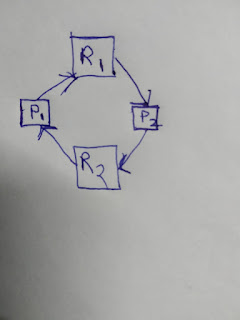
Necessary condition for Deadlock A deadlock system contains process and resources satisfy by the following the 4 condition. Mutual exclusion: -It means resources are (at least one) in non shareable mode only. -It means only one process at a time can use the resources . -If some other process request the resources than the process will must wait until the resources has been released. -e.g A printer is a non shareable device bcz the printer can,t be share by the multiple no of process at a time. Hold and wait: -each and every process in deadlock state and must held at least one resources and waiting for other resources which again held by other process. -p1,p2,p3 are 3 process and r1 , r2 , r3 are`3 resources each process can must hold resources.      in this diagram p1 is holding the resources r3 and waiting for the resources r1 and p2 is holding the resources r1 & r4 and waiting for the resources r2 & r3.        p3 i...

What is deadlock situation(OS-1)

Image
Deadlock -In the multi programming environmental several process may compete for finite no of resources. -A process request resources if the resources is hot available at that time a process enter to the wait state and waiting process may never changes its state bcz resources requested are held by other waiting process.                               This situation to called deadlock   if process are p1 and p2 or resources are r1 and r2 .process p1 request to resources r1 and the resources r1 is held by the process p2, process p2  request r1 is held by the process. p2 process request r2 but the resources r2 is held by the process p1. In this situation two process can,t start their operation.                  so process are enters in waiting state , this situation to called deadlock situation.           ...

what are the network types and explain(DCCN-4)

Image
Network types -The computers are interconnected to information among them which can for mean a computer N/w. -the computer network type is 3 types:                                                                  1.LAN(Local area network)                                                                  2.MAN(Metropolitan network)                                                                  3.WAN(Wild area network) LAN(Local area network) -LAN is usually private own network in which...

what is line configuration(DCCN-3)

Image
Line configuration -it is refers to the way two or more communication devices to attach to the link. -a link is a physical  communication path which is transfer the data one device to another device. -it is the two types of line configuration:                                                                    1. point to point line configuration                                                                    2. multi point line configuration point to point line configuration: -point to point line configuration is provided to  dedicated link between the two devices. -the entire capacity of the link and challenge for dat...

What is topology and types of topology explain briefly(DCCN-2)

Image
TOPOLOGY -IT means the computer network is layout either physically or logically two or more devices connected to the link. -Two or more link indicate to the topology structure.it is the geometric representation of the relation of all the link and linking devices to each other. types of topology 1.mesh topology 2.star topology 3.ring topology 4.bus topology 5.hybrid topology 1.mesh topology: the mash topology has a dedicated point to point  link to every other devices. advantages:   -the use of dedicated link guaranties that each connection can Carrie   it,s own data thus elementary data to the traffic problem that can occur when the link can share by the multiple devices. -the mesh topology is the robust. if one link be come useless it did,t indicate to the whole network out of order. disadvantages: -the mash topology have a large no of cabling and large no of i/o points are required. -as every device must be connecte...

what is Data transfer (DCCN-1)

Image
Data transfer -I t is the way to communicate data and sharing data the sharing can be local and renote -it is the exchanging of data a between two devices and same transmission medium like wire and   wireless. -in whole communication system then must a physical component equipment and software. -the data communication system depended in 4 major characteristics.these are 1.delivery                                                                                                                               2.accuracy                                       ...